Showing posts with label Food. Show all posts

Monday, January 25, 2016

Western Morning, Southern Afternoon

While the East Coast got pounded by record-breaking blizzards, we were enjoying an absolutely blissful weekend here in Boulder. It was sunny and clear, and although the mercury topped out in the mid-50s, it felt much warmer than that when one was in the sun. It was a perfect day for a hike, so I packed Mischa into the car and joined some friends at a trailhead a mere eight minutes' drive from our house. The park is called Chataqua and it's criss-crossed with trails that lead up to the nearby Flatiron Mountains. Here is Mischa, posed and ready for hour hike.


Most of the pictures I took ended up looking more like this, so I was pleased with the shot above:


Although the day was warm, the trail was very, very icy, but fortunately everyone in our group had the good sense to bring spikes. This is a product I didn't know even existed for most of my life, but in Boulder it's indispensable. I actually own two different types, one like the picture to the left and the other with smaller spikes under the ball of my foot and springs to dig into the snow that run under my heel. They're great because they're light enough to carry easily if you don't need them, but they make it possible to walk up slick surfaces that would be nearly impossible otherwise. We cruised by lots of hikers who were slipping and sliding along the trails and turning back early. Perhaps that is why the area wasn't as crowded as it ought to have been, considering the wonderful weather. We had a great time.

Mischa, who had no spikes, did an excellent job anyway. Ed and I had taken her up Mt. Sanitas, another nearby trail, earlier in the week, so this wasn't her first rodeo. Sanitas involves lots of scrambling over small boulders, and we were pleased that Mischa, who had never done anything like that as far as we knew, had little trouble picking out and executing a path over the rocks. She seemed to have a great time, and she was cheerful on our Saturday hike, too (which had no boulders to climb over and so was easier going). She hardly pulled on her leash at all, which is an improvement, was serene instead of anxious when passers-by attempted to pet her, and even did a fair job of ignoring many dogs we passed. (We still have a lot of work to do on this front.) She ended up muddy, tired, and happy.

Having worked up an appetite on the trails, several of our friends and I made a bar in South Boulder our next stop because they were hosting a crawfish boil. They do this a few times a year, apparently, and I will most definitely be back for the next one. Crawfish came in one-pound baskets or three-pound buckets, accompanied by corn on the cob (a little overdone) and boiled potatoes. I dispatched my own basket and part of a friend's, then helped Ed with a three-pound bucket. They were delicious and fun to eat. The only place I'd ever eaten crawfish before was a New Orleans-themed restaurant in Manhattan, so I have yet to rack up an "authentic" experience, but I'm not complaining.

Our bucket

I will be on the road quite a bit for the next few weeks, but I couldn't have asked for a higher note to go out on.

Sunday, March 29, 2015

Beer Pairings at the Sanitas Brewery

Hardly a week goes by that I don't have at least one email from my new friend Candice. She always seems to know of something fun that's happening in the Boulder area and she loves to get groups together to see what the town has to offer. Her most recent invitation was to a dinner at the Sanitas Brewery, and Ed and I decided immediately that we were most definitely in.

The Sanitas taproom. 
After purchasing tickets for $30 a pop, we showed up on Monday night at a row of warehouses just off the highway. If this were any other town I'd have thought we were in the wrong place, but craft breweries in Boulder tend to set up shop in warehouses so I wasn't worried. Sure enough, after parking in view of forklifts and roll-up doors, we walked into a cavernous room containing several high-top tables and a modern-looking bar with large steel tanks and silvery pipe networks visible in the background. Young men, most sporting beards, walked by every few minutes, sometimes carrying lengths of tubing or buckets and all wearing t-shirts and galoshes.

Our group of about 12 was seated at a square table instead of a typical long, skinny rectangle; this wonderful set-up was perfect for whole-group discussion. Only one other small group had signed up for the pairing, which would normally seem ominous but I wasn't worried because this was Sanitas's first pairing dinner. Both of our tables were in a small room separated from the main bar area by large sliding doors. 


Zach and Clay took us through the evening's proceedings. Zach is one of the co-founders of Sanitas and Clay runs the McDevitt Taco Supply truck with his brother. Lots of breweries in Boulder are supplied by food trucks because, as Zach explained, in the beer sales world the difference between a second beer and a third beer is food, but most brewers don't know anything about the food industry. So a lot of breweries bring in mobile food providers, like food trucks, to supply their customers with sustenance to be washed down.

I'd drunk about half the beer when I took this.
Zach told us about the origins of Sanitas Brewing and Clay walked us through the history of his taco truck before we got to talking about the menu. Then the fun really began. We went through three courses plus dessert and each was served with a too-generous portion of beer. (Most people, thinking ahead to the drive home, left their glasses only partially emptied.) Before each course, Clay talked about the food and then Zach explained why he chose each beer to compliment it. Both had interesting things to say, but the acoustics in the room weren't great and I felt lucky to be sitting fairly close to the front. I liked the tuna course we started with, though I would have been grateful for more of the delicious pineapple pepper sauce. The jalepeno butternut squash soup was a fresh take on the old staple, but it was not for the faint of heart; Clay was generous with the jalepenos and it was very spicy. Just as Zach promised, though, the black IPA served alongside it put out flames with a single sip. The two complimented each other on other levels, too, however, and it was wonderful. I think this was the first time I've ever really experienced true synchrony between beer and food and I was surprised to find it almost as complex and pleasing as a good wine and food pairing. I was served a last-minute tilapia fillet while everyone else set to work on a massive portion of ribs; mine was delicious and Clay made sure to stop by to ask me how it turned out. Next time Sanitas hosts another such event, they'll have to be careful, especially in a town as liberal as Boulder, to have vegetarian options available. The dessert course, a dark chocolate chipotle brownie paired with a coffee-infused beer with hints of vanilla, was an inspired ending. 

This casual yet decadent dinner was wonderful. It was both an enjoyable social gathering and a learning experience. The portions, both of food and beer, were generous and everyone agreed that the meal was well worth the price we paid for it. 

I look forward to visiting Sanitas again, for a casual beer or for another wonderful, multi-course dinner.


Sunday, November 16, 2014

Baking in Boulder - Cornbread and Banana Bread

Boulder is just over a mile high. The altitude affects the way you breathe when your heart rate accelerates, though this improves with time. The altitude also affects the way foods and liquids behave when you cook them, but this does not improve with time.

Basic cooking doesn't change much. Water takes longer to boil and boils at a lower temperature because...science. Your stir fry or steamed broccoli is going to take a tad longer but will generally come out in Boulder the same way it would at sea level.

Baking is a different ball game.

The quality of the air affects baking in up here: its drier and its thinner. The dryness is easy to wrap your head around; extra liquid--just a bit--is needed and that's all there is to it. The thinner air, however, affects the way doughs and batters rise, and this is where things get interesting. For one thing, you have to adjust the amount of leavening (baking powder/soda or yeast), though there's no formula for the precise amount to omit. Other factors come into play in unexpected ways, too; for example, if you over-beat your eggs before adding them to your batter, the excess air will cause problems. Too much leavening or too much air in your eggs means that your baking will rise so fast that it will collapse, yielding decidedly unattractive, and probably less tasty, results. One more thing to keep in mind is that because water takes longer to heat up, you have to increase oven temperatures.

Most cookbooks are written for sea level cooks, and recipes I've baked for years with great results now need tweaking. But no set of exact steps exists, so I'm launching into experimentation, making notes all along. My system, so far, is to jot down the changes I make and the outcome on a sticky note, which I attach to the recipe.

My first venture was Mark Bittman's cornbread recipe. First, I set the oven to 400 degrees instead of the recommended 375; he suggests adding 25 degrees to baking temperatures above 3,000 feet. I reduced the baking powder from 1 1/2 teaspoons to 1 and used 1 1/3 cups of buttermilk instead of 1 1/4. I'd read that covering things while they baked could prevent them from drying out, so after 15 of the 30 minutes it was supposed to bake, I tented the pan with foil. The sides looked done, or even perhaps a bit overdone, at 30 minutes and the toothpick came out clean, but the top was a bit pale.


The color, I figured, was the fault of the tent, so I fired up the broiler to give it a little color. I then violated one of my most sacred kitchen rules and started doing something else while the bread was under the broiler instead of watching it closely. Oops. I pulled a somewhat splotchy loaf of cornbread out probably 90 seconds after what would have been ideal and frantically tossed the pan into a snowbank for a few minutes to stop the baking process.


I was nervous to taste it, but the result was a pleasant surprise. The bread was moist and the texture was perfect. Next time, I'm going to try tenting for the first 15 minutes, then removing the foil to let the top bake for the next 15. As far as the ingredients, I don't think I'll change a thing.

My next venture was banana bread (or, rather, banana bread muffins since I was making only a half batch and don't have a loaf pan small enough). Again, I started with an oven 25 degrees hotter than recommended. The halved recipe calls for 1/2 tsp baking soda, but I used only 1/4 plus a tiny pinch more, and instead of 3 1/2 TB sour milk I used 4. I didn't tent the muffins at all after the fiasco with the cornbread. This, I think, was a mistake. The muffins were done in 36 minutes. (A full-sized loaf, according to the recipe, takes an hour. Not sure about sea-level muffins.) Interestingly, they were paler inside than usual and yielded fewer crumbs. Ed deemed them delicious, and while I agree that they're pretty good I think I still have some work to do. The texture inside is good, but they have a crispy crust all around the outside that they never had before. Could this be the fault of the higher temperature? Should I have covered them for at least part of the baking time to counteract the dry air?


I think I will try foil next time and then, if that doesn't work, lower the temperature.

Baking up here is certainly an adventure, and while I am sort of enjoying the discovery process, it will be a long time before I attempt a soufflé.

Monday, November 10, 2014

Snow and Tea

Ed and I hiked around the Glacier Gorge area yesterday and encountered some snow at that elevation, but it was still pleasantly balmy down in Boulder when we returned. This morning, however, the wind picked up I spotted some tiny flakes at about 11:00 this morning. The flurries got flurrier and we've had a steady snowfall for hours now. According to forecasts, Boulder should get a mix of rain and snow for the next few days. The high tomorrow is 19!


We ventured out of the house this afternoon in search of lunch and wandered into the Dushanbe Tea House, a very cool spot that was just the thing for a chilly day. The tea house was a gift from Boulder's sister city, Dushanbe, Tajikistan. It was built there, then disassembled and shipped here. The intricately painted ceiling, the impressive wooden columns (no two are alike!) the ceramic tiles on the outside of the building, the bronze figures in the fountain, and the carved plaster panels were all handmade by artisans in Tajikistan, and no power tools were used in any part of the construction.


To ward off the chill, Ed got a pot of a tea called something like Moonbeam Spice and I got a blossoming tea. Both were great, which was a relief because I didn't want to have to return to their impressive but rather overwhelming tea list, which contains more than 100 choices. The food on the menu is eclectic, offering everything from Mexican to Italian to Indonesian to Vietnamese. I ordered spicy peanut noodles, which were delicious, and Ed enjoyed his Tajikistan Plov, which is a traditional rice dish served with seasoned beef on top. The dessert menu had some intriguing items on it, such as pistachio soup, spiced chocolate cake served with avocado ice cream, and tangerine tea gingerbread, but, alas, we were too full. Next time. I also look forward to going back to try their breakfast offerings, and for their high tea service, which is available by reservation only each afternoon.

Ed and I have both enjoyed the food in Boulder, and the Dushanbe Tea House is yet another great player in our new home's impressive line-up.

Thursday, September 25, 2014

Sushi Nakazawa

It's a miracle I can still zip up my pants.

If you have not seen Jiro Dreams of Sushi, stop reading and beg, steal, borrow, or download it
Chef Nakazawa is second from the left
immediately. This fascinating documentary is drool-worthy, both because it is so well done and because it takes everything you think you know about sushi to the next level. It is the story of Jiro, a sushi chef, and his simple sushi restaurant in a subway station in Tokyo that has three Michelin stars. Ed and I watched it a while ago and were smitten, so when we learned that Jiro's apprentice, Chef Daisuke Nakazawa, had opened a restaurant here in New York, I immediately set about getting us reservations.

This was easier said than done, however. There are only three seatings a night at the bar for ten people each, and I was told that we might as well not go at all if we didn't sit at the bar. One can make reservations starting at midnight for up to 30 days in advance, so I set my phone alarm several times in a row and logged in to the site. Again and again I was beat out. I was beginning to get desperate; our time in NYC was dwindling, and our odds of getting into this place were looking bad.

I mentioned my woes to my savvy friend Maggie, and she recommended a new app called Shout. The idea is that if you have something valuable that you can't use--concert tickets and reservations, mostly--you can list it on Shout and other users can claim it and reimburse you. In principle, this is a great idea, but of course some people are making a lot of money by signing up for reservations for the express purpose of auctioning them off. One can make up to $50 a pop for this. Since this was making a limited commodity even more limited, I disapproved of the model. Then again, I didn't have any other ideas. So I scoured the Shout listings for several days and finally found and paid for a reservation. We were in.

The experience was absolutely worth the $50 reservation and gray hairs it cost. Ed and I showed up a few minutes early and had to wait until exactly 9:30 when our reservation was to start. I didn't mind, though, as I was drinking in my surroundings. The restaurant was polished and elegant, generally quite simple, though the framed pieces of lacquered tuna on one of the walls were certainly worth a double take. The small dining room (I didn't count but I estimate there were eight tables) was in the back, and the space behind the sushi bar was humming with activity. About four sushi chefs, all men in whites, sliced and diced all manner of interesting sea life and scooped rice from a large urn by hand, laying their finished creations in the centers of pretty plates to be whisked off to tables by the formally-dressed staff.

Chef Nakazawa broils eel for a table
At one point, a cheery middle-aged man, also in whites, appeared among the chefs. He poured himself some steaming green tea from a tap--these are common in Japan, sort of like samovars in Russia, I imagine--and immediately pretended to splash it, giggling, onto another of the chefs. Ed and I had been trying to figure out which one of the men was Chef Nakazawa, and a quick trip to Google revealed that this practical joker was the great man himself. He wore the same uniform as everyone else and didn't appear to be giving orders or inspiring particular fear in the hearts of his chefs. The difference between him and the dour Jiro was stark.

Then we were escorted to our places at the bar and invited to settle into exquisitely comfortable chairs. There was no food menu, of course, as the menu was set, but we were asked about food allergies and invited to order the sake pairing (which, of course, we did). There was little talk at the bar; everyone seemed to be watching the chefs just as intently as I was.

Each piece was served one by one by the man himself. Chef Nakazawa's assistants would cut pieces of fish with great precision and lay them gently on little pillows of rice and sometimes he would even assemble the sushi himself. Then he'd lay a palm flat and load it up with five or six tasty morsels, deposit one each on the stone slabs in front of each diner, then repeat so that everyone had a piece. As he served, he'd announce the type of fish in thickly accented English that was very difficult to understand. I made certain to chase each piece of sushi with a piece or two of freshly sliced Hawaiian ginger and sips of crisp, tasty sake.

I made very careful notes as I ate to ensure that I didn't forget anything. The courses were:
  • salmon
  • smoked sockeye salmon
  • "dancing" scallop - this was served alive. After placing each piece down, Chef Nakazawa would stroke the flesh of the scallop lightly with his finger and it would undulate in response. This was, obviously, a little strange and we diners all exchanged alarmed looks, but I decided to hide my squeamishness and go for it. The scallop was firm and delicious (though I was rather glad we were served only one), and Chef Nakazawa completed the experience by pressing a button on a small red radio that let out a shrill, cartoonish scream as we all chewed. It was pretty funny and helped me not think too much about what I'd just swallowed.
  • giant clam (geoduck)
Our first piece - salmon

  • trigger fish "with own liver"

Trigger fish with its liver garish - one of my favorites
  • fluke - To convey to us how fresh the fluke was, Chef Nakazawa announced proudly, "Kill here." Then he pointed at a sheepish looking chef and added, grinning, "He do it."
  • barrel fish
  • horse mackerel - out of Chef N's mouth, this sounded like "hose mackerel" and in response to our confused looks he made a riding motion with his hand and recruited the maitre'd to help translate
  • baby gizzard shad - another one that got lost in translation until Chef N assured us, "English person coming," then yelled "Engrish, onegaishimus!" (English, please!)
  • massaged octopus, of Jiro fame - absurdly tender
The best octopus one can eat outside Japan
  • jumbo shrimp
  • golden stripe yellowtail
  • smoked bonito
  • a tuna trio: plain blue fin, "soy marinated lean part," and fatty tuna

Tuna, arranged in order of decadence 
  • sea urchin with truffle salt - I must have looked particularly transported while chewing this piece because Chef N looked at me and asked, "You like it, ha?" My mouth was too full to answer, but I nodded emphatically. He jerked his head at me and said to no one in particular, grinning, "I find a happy face."


  • soy cured salmon roe
  • anago eel
  • tuna handroll
  • tamago - for those who have never tried tamago: it's sort of like an slice of an omelette, though I think there's a bit of sugar mixed in because it's always sweet. I tasted my first piece at the Tsukiji Fish Market in Tokyo--a friendly shopkeeper handed it to me to try and explained in broken English what it was--and I've been a big fan ever since.
The meal was capped off with fruit sorbet. I thought I'd be too full to eat it, but I ended up scraping my bowl clean. 

It's difficult to explain how good each piece was. I was torn between feeling as though I couldn't possibly ever eat anything else ever again and wishing the chefs would keep serving us tidbits all night. Ed and I staggered out of the restaurant way past our usual bedtime stuffed, sleepy, and utterly content. 

All of this cost more than peanuts, of course, but dinner at the sushi bar is really an incredible bargain. I can't recommend this restaurant enough, though I would be a lot less excited to eat at a table. The show is more than half the fun.

Thursday, September 11, 2014

Eleven Madison Park

Maggie, one of our favorite foodie friends, had been trying to get us reservations to go to a very fancy, highly renowned restaurant called Eleven Madison Park for ages. Part of the problem was that our group was to have six people in it, which made things challenging. Meals and Eleven Madison have many, many courses and take forever, and so it was a bit of an unconventional idea to go there for lunch. But when she told us she'd gotten us spots there for 1:00 on Saturday afternoon if we wanted them, we all jumped at the chance.

Eleven Madison Park is an elegant restaurant with sky-high ceilings and simple, classy decor near Madison Square Park. Alas, no pictures are allowed inside the restaurant, so I don't have any images of our meal to share; I was actually rather glad about this policy, however, because it allowed me to worry only about enjoying the food and not capturing every mouthful on film. It was a little strange to get all dressed up for a weekend lunch, and other than great food and lots of courses I wasn't quite sure what to expect from the experience. I've eaten at a few restaurants similar to Eleven Madison before, and while the food is almost always delicious sometimes they can be a little stuffy. Eleven Madison was anything but, however. Each of the fourteen courses (!) we were served over the four-hour meal was painstakingly crafted and delicious, and many were also creative and almost whimsical.

Smoked/Smoking sturgeon
The theme of New York was woven throughout the meal. We started with a box of the restaurant's take on New York's ubiquitous black and white cookies. Instead of being sweet, though, these were savory and included cheese. I could have eaten a whole stack. Other courses included things like smoked sturgeon (served under a still-smoky glass dome) served with caviar, cream cheese, and pickle spears, and a salad garnished with bread crumbs seasoned like everything bagels. One of my favorite courses came to us in a picnic basket that we got to unpack ourselves. Inside, we discovered ceramic dishes made to look like paper plates, pretzel sticks, raspberry mustard, soft cheese, and wheat beer. There was also a seafood boil course in which a pot of clams, shrimp, lobster, small potatoes, and baby stuffed peppers was dumped artfully on a board in front of us, then seasoned with herbs, spices, and a generous flood of lemon juice. All of this makes Eleven Madison sound casual; those who've heard of it know that it's anything but. But its class and refinement is accompanied by a good sense of humor.

The picnic basket, which was a fun change of pace from the other impossibly intricate courses we were served.
We noticed the same attributes in all of our servers, who joked with us while waiting on us hand and foot. I had scarcely settled into my seat upon arriving before a woman to my right had deftly placed a purse hook at the table which she invited me to use. Each time anyone from our table returned from a trip to the powder room, a staff member was ready to help push their chairs in for them.

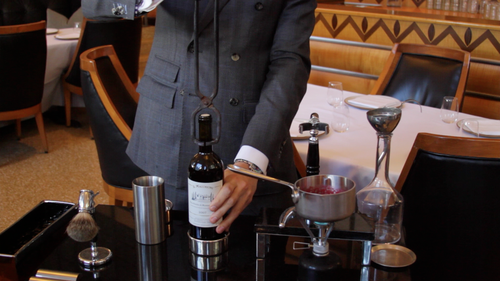
Screen Shot 2013-09-04 at 1.26.17 PM.pngThe sommelier not only made good recommendations but also put on a great show. Nate, one of our party, is a major wine fan and had spent the previous evening poring over Eleven Madison's wine list. He was ready to go and after conferring with the sommelier put in an order for two bottles of burgundy. To our great surprise, the man returned a few minutes later pushing a cart bearing two bottles of wine and what looked a lot like Medieval torture devices. He explained that lots of old wines had to be opened through other means because sometimes the corks had been degraded, and that while this wasn't likely to be the case with our wines, it was a fun show anyway. He then heated a large pair of tongs--called port tongs--over a burner and fit them over the neck of each bottle in turn when they were glowing red. One of the bottles cracked neatly and he was able to lift off the whole neck in one piece, cork and all. The other required dabbing an ice-water-soaked shaving brush before it came off. Both wines were decanted through fine sieves before they were served and the broken parts of the bottle were dipped in wax. (Interested in learning more? I found this video of another sommelier from Eleven Madison demonstrating the process).

This is about a third of the kitchen.
We were the last ones in the restaurant and were thrilled when a maitre d' told us we were going to get a tour of the kitchen. (Turns out Maggie had been gently but insistently "suggesting" to the staff that we'd love something of the sort for some time.) After a round of complimentary apple brandy that was too strong for me to do more than sip at nervously, we were ushered back into a massive, sparkling kitchen. We were served boozy snow cones made from a block of ice shaved before our eyes with a beautiful 100-year-old ice press and invited to feast our eyes on the pre-dinner activity around us. There was a swarm of chefs in tall white hats at each station all busily spooning, chopping, and whisking. I watched one man plating a course; he passed a single daub of some sort of sauce back and forth between a pair of spoons about eight times before he was happy enough with its shape to place it on the plate.

In the kitchen was a large poster of Miles Davis. On another was was a framed poster of a list of words and phrases. Our "tour guide" pointed these out and explained that once an early critic gave the restaurant three-and-a-half out of four stars, saying it was very good but that he wished it had a little more Miles Davis. The master chef at Eleven Madison took this to heart and launched into some research. He and his team compiled eleven adjectives describing Davis and his music: cool, endless reinvention, inspired, forward moving, fresh, collaborative, spontaneous, vibrant, adventurous, light, and innovative. These words were printed and framed and now they serve as a reminder of the restaurant's food and service philosophy to everyone that spends time in the kitchen.

Chris Flint, chef and Cheley alum
The czar of the kitchen was the chef de cuisine. He tastes every single thing before it is carried out to diners with a bevy of plastic spoons and all of the chefs must respond to him with "oui" instead of "yes" according to custom. He came over to nod seriously at us and ask us if we'd enjoyed our meals. We all babbled happily. Then he asked if we all lived in New York. Everyone nodded, though Ed said that he and I were getting ready to move to Colorado. The chef sighed and said that he loved Colorado; in fact, he'd spent his childhood summers at a camp in Estes Park. "Which one?" Ed and I insisted just about in unison. Amazingly, he and Ed not only attended the same summer camp, but were there at the same time. The chef's face changed from polite indifference to real interest and he and Ed talked about how this camp had changed both of their lives. Ed asked his name (Chris Flint) and then introduced himself. "I saw your name on the wall!" the chef said, his eyes widening. "You were a Fourth Degree Mountaineer*!" Ed looked a little abashed and said that yes, he was, and the chef wrung his hand with a look of intense respect on his face. We all chattered for a few minutes about how small the world is, then he had to get back to work, though he shook all of our hands again and wrung Ed's with special intensity.

As at many fancy restaurants, we were given parting gifts. Each person got a copy of the day's menu in an envelope and a jar of absolutely delicious, house-made granola. It has pistachios, pepitas, and dried cranberries in it and it has been making my mornings a little easier to face.

One certainly can't eat a four-hour lunch often, but it's pretty fantastic to get to do something like this now and then. I was inspired by the creativity at Eleven Madison Park and had a wonderful time sharing the experience with Ed and our friends. I can't say just when we'll go back, but since the menu changes seasonally I'm certainly excited for more surprises the next time I return!

*At Cheley, being deemed a Fourth Degree Mountaineer is a big deal. Ed estimates that when he was at camp there were only about 20 names on the wall, and the list started in the 1920s! So it's no surprise that Chris Flint noticed Ed's name there.


Monday, August 18, 2014

Delicious Weekend

One of the things I will miss most about New York is the food. There are a lot of wonderful restaurants here, great food is only part of the story. There is a diversity here that can't be beat. This weekend was a case in point.

Stock photo. It wasn't *this* empty.
Saturday night we joined our friends Maggie and Leonard for a memorable meal at Jungsik, an elegant Korean restaurant in TriBeCa. Jungsik is the only Korean restaurant in the United States to receive any Michelin stars, and it happens to have two. Apparently it was quite difficult for Maggie to secure the reservation there, but the place had few other tables throughout the evening. If this is typical, I'd recommend simply trying to walk in on weekends. We opted to order the set tasting menu and worked our way through many tiny, intricate, and delicious dishes. Everyone's favorite were the fried oysters, which were breaded with squid ink and seaweed and were absolutely heavenly. Maggie and Leonard added the wine pairing to their meals and, as Maggie was kind enough to let me taste each of her pourings, I can assure you that the choices were thoughtful and added a great deal to the food. The service was impeccable as well. When our waiter asked Maggie if we were celebrating something, she told him that Ed and I had "just" gotten engaged. We didn't get any freebies, but the kitchen did write a message on one of my dessert plates.


Sunday morning Ed and I had hoped to take my brother to a restaurant we love called the Tipsy Parson for breakfast, but there were no open tables. So within several minutes of strolling we happened upon a great French restaurant just down the block. We'd never heard of it, but in no time we were being served plates of poached eggs perched atop piles of ratatouille and potato pancakes. In many other cities this restaurant would probably be one of the best in town, but in New York great places like this are so common that I didn't even make note of its name.

We met our friends Mary and Rasool for drinks and dinner on Sunday night. The first stop was a bar called the Pegu Club that has been on my to-do list for several years. Backstory: When Ed and I went to Berlin a few years ago, we arrived too early at a restaurant where we were supposed to meet Anthony and Jane and so went to the cocktail bar next door to wait. The bartender made great drinks and spoke good English. We started talking about craft cocktails and he told us that his favorite place in New York was the Pegu Club. I wish I'd taken him at his word before this because he was right; it was great. The bar is named for a British officers' club that used to exist in Pegu, Burma. The space felt at once refined and tropical. We sat in chairs upholstered in pale green velvet next to a wall covered with green and gold wallpaper with a leaf motif. I ordered from the colada menu and immediately felt terrible about it because my drink took the poor bartender almost ten minutes to prepare. (When I apologized, he shrugged and said only, "It's really good.") Most of that time was devoted to shaking and shaking and shaking the drink until a layer of frost formed on the outside of the metal. Then the concoction was poured into a glass to sit for a while between occasional thumps from the bartenter. A layer of foam eventually floated to the top. He removed a straw-full of the drink, tasted it, then poured a bit of sparkling water into the hole in the foam and finished it off with a few dropperfuls of liquid cardamom. Needless to say, it was absolutely wonderful. As if the atmosphere weren't appealing enough, a jazz band had started to play silkily in the background while we sipped. I was sorry to leave.

Another stock photo. This place was hoppin' when we left.
But I wasn't sorry for long, because our next stop was equally great, if completely different. On our way to the Mermaid for dinner, we passed Miss Lily's and were enticed to change course. And I'm so glad we did. I've been hearing about how great this place is for a while, and it did not disappoint. Miss Lily's is a Jamaican restaurant with a funky vibe that made me feel as though I was on vacation. We ordered with abandon, starting with grilled corn on the cob, spicy shrimp, and plantain chips with akee dip. Everyone else ordered something with jerk sauce for their entrees (jerk chicken, jerk salmon, and jerk pork) and I ordered the wonderfully (if bafflingly) named Buss Up Shut, a popular Carribean dish made of pan-fried bread dough. Like many of the things on the menu, I had to google it. It came with shrimp and vegetable curry and was heavenly. "I'm really full and I can't stop eating," Ed complained, and we all nodded emphatically and kept stabbing with our forks. Rasool, who played professional soccer, reminisced about living with several Jamaican soccer players in college who used to make this kind of food all the time. We washed it all down with Red Stripe and listened to old-school hip-hop. It was awesome.

Boulder has some great restaurants, but it's a fairly safe bet that places like Jungsik, the Pegu Club, and Miss Lily's won't be there. Of course, few cities can boast this kind of restaurant scene. Ed and I had better prepare to return from our visits to New York several pounds heavier.

Tuesday, August 12, 2014

Dinner with The Chef

Preamble: I am sworn to secrecy about certain aspects of last night's events, so today's post is necessarily cryptic. Because at least a few of you will know one of the characters below and be able to put the pieces together, I will refer to him, and his associates, with pseudonyms. My apologies. I'll let the cat out of the bag as soon as I'm able.

My hometown friend, whom I'll call The Chef here, went to culinary school and spent the years thereafter slaving away in kitchens under the command of other chefs. His hard work finally paid off about a year and a half ago when he answered, of all things, a Craigslist ad seeking a head chef for a new restaurant in California. He was hired and the restaurant opened its doors several months later. Since then, the restaurant has been receiving rave review from professional food critics and patrons alike. I hadn't seen The Chef in years but had followed his successes on Facebook and was very happy for him.

I was even happier when he sent me a message to say that he'd be in New York and would like to meet up. The "we" in the email turned out not to mean The Chef and his very  nice wife but instead The Chef, The Owner (of the restaurant) and The Pastry Chef. I was eager to catch up with The Chef and meet his coworkers, and we made arrangements to meet at Peasant, a restaurant downtown.

Ed and I arrived at Peasant first to find it looking decidedly closed. The Chef and entourage showed up moments later, and since The Chef, it seemed, had accidentally booked our table for Tuesday instead of Monday night, we altered course. It turns out that The Owner had lived in New York for years and he and Ed had a favorite French restaurant, Lucien, in common.

Lucien
As we walked to Lucien (here comes the secret), The Owner asked The Chef if he'd told us why they were in New York. It turns out that The Chef's restaurant has been chosen by the Bravo network to compete in a TV series called Best New Restaurant (or something like that) that will air in January. Their restaurant and 15 others selected from LA, Miami, Austin, and New York, were selected to compete in a series of challenges. The first taping was done in their restaurant a while ago: cameras filmed the cooks in the kitchen, the service staff delivering the dishes, and The Owner running the show. They'd traveled to New York for the first official challenge and were due to be picked up by a van at their hotel at 8:30 the next morning to be taken to an undisclosed location. There, they were to cook and serve a three-course meal to a panel of judges alongside chefs from another restaurant in the competition. A coin flip would decide who cooked and served first, and they weren't yet sure whom they'd be competing against. They were, however, allowed to plan the menu themselves instead of being made to incorporate bizarre ingredients or do everything in only half an hour like on some cooking competitions. All three were nervous about the outcome, but they said they'd rehearsed everything enough times that they were confident that they'd perform well.

We stayed at Lucien for more than three hours. The Owner ordered several hors d'oeuvres that he shared with everyone, and The Chef ordered a large bowl of mussels that he declared some of the best he'd ever eaten. (I sneaked a piece of baguette into the broth and agreed that it was sublime.) Everyone, even the sweet and soft-spoken Pastry Chef, deemed all three desserts wonderful. We talked and talked and talked about food. The Owner, it seems, knows his way around a plate but has very little input in the decisions that take place in the kitchen. He leaves all that up to The Chef's good judgement. The menu changes about every six weeks and is inspired by seasonal offerings. The Chef visits the local farmers' market and uses whatever fresh ingredients he can. The Pastry Chef referred to The Chef as "Chef'" instead of by his first name (e.g. "Chef tried it and made some suggestions."), which I found rather amusing. The three seemed to have a friendly, functional working relationship and their enthusiasm about their restaurant and food in general was infectious.

By the way, I asked The Chef for the most common mistake home cooks make and he said, after some thought, that it all has to do with salt. Kosher salt, not the little iodized grains, is his seasoning of choice during cooking, and he said that failing to season throughout the cooking process and instead waiting until the end results in flat flavor. Before serving a dish, he likes to add fleur de sel.

I'll be anxious to hear about the results of the first competition, which they'll learn at the end of taping today. If the other restaurant beats them, they'll be eliminated from the competition and go back to running their highly successful restaurant without lights and cameras. If they win, they'll be promoted to the next round. Regardless of how it turns out, Ed and I already have plans to be in their city in a few months from now, and I look forward to plunking myself down in the restaurant and letting The Chef and The Pastry Chef work their magic.

Sunday, March 23, 2014

Blue Hill and Other Adventures in Westchester

Three months ago, I staggered out of bed in the middle of the night to secure a reservation for six at Blue Hill, a restaurant in Westchester that is positively legendary, for Ed's birthday. Blue Hill is located on the grounds of Stone Barn Farms, a sprawling piece of property north of New York City that produces a stunningly diverse array of organic produce and meat and dairy products. (There is also a location in Manhattan, but I have heard that it is not as impressive.) The menu changes constantly according to what is in season, and it's frequently lauded as one of the best restaurants in the country. I'd heard that the multi-course menu takes a long time to get through, and so I arranged for us to stay at a nearby hotel to make a getaway of it. Three months seemed to drag by, but finally we found ourselves driving out of the city yesterday, headed toward what promised to be a memorable celebration.

The Castle, with its lion head-adorned fountain
We checked into the impressive Castle Hotel and Spa in Tarrytown, where we were welcomed by an exceptionally courteous staff and ushered into the lovely lobby to drink complimentary champagne while we were being checked in. The Castle Hotel used to be a house, and I certainly wouldn't mind living there. It's beautifully decorated with wonderful details; some are obvious, like the gorgeous carvings on the wooden banister bordering the central staircase just of the lobby. Others, like the small light fixtures shaped like armored knights tucked up near the ceiling on either side of the main door, are delightful surprises. In our large, comfortable room, we were greeted by a plate of chocolate-dipped strawberries and told that the items in the minibar were complimentary. Part of our room was in a turret, and the rounded wall housed a row of windows that provided a sweeping view of treetops and a river on the horizon.

After settling in and dispatching some of the strawberries, we went for a run that took us by a pretty, ice-covered pond and through some forested, rolling hills. Then, at last, it was time for dinner.

I was in love with Stone Barns Farm, and its restaurant Blue Hill, before we were even out of the cab. Off the main road, we approached an imposing stone building via a hilly, curving road that took us past a cow pasture and a field filled with wheeled hen houses. A brick walkway took us through an entryway into a courtyard in which a row of flickering lanterns on the flagstones led the way to the entrance of the restaurant. Inside, a warm, elegant bar and a friendly hostess greeted us, and we were handed a cocktail menu that listed drinks like Pickled Ramp Martinis.

Our friends arrived soon after we did, and we were escorted into a large, airy, dining room. Unlike in the city, there was plenty of space around the tables, and the chairs were upholstered and comfortable. Running through the center of the room was a long, wooden table from which soared an incredible sculpture made of branches and hung with flowers. Potted succulents were nestled in its curves.


An Australian man in a suit placed an enormous parsnip, nestled in a trough-like section of log, in the center of our table and told us about how it had spent the winter growing in the soil just outside the dining room, where the cold concentrated its sugars. He was to intersperse our many, many courses with changing centerpieces and poetic information about the food and the philosophy behind many of the seasonal dishes. We settled in to peruse the menu and found that we had a choice between only two set tasting menus. We ended up settling on the longer one. After that, we told our host about allergies and dietary restrictions and our decision-making for the evening was over.

Shear-Your-Own Peashoots
What followed was a kaleidoscopic array of courses, each simple, fresh, beautiful, and spectacularly delicious. I lost track after a while, but here are some of the ones I remember: an array of baby carrots, radishes, bok choy leaves, and cauliflower florets impaled on nail heads protruding from a pretty polished board; a bit of yellow wax bean served with a rich smear of steamed, seasoned egg yolk; "beet sushi," a thin slice of beet arranged over a little cushion of warm grains and crunchy sesame seeds; kale and cabbage chips in long strips woven amongst the protrusions of a striking black branch-like sculpture; a tiny "beet burger" that tasted like the most wonderful sloppy joe ever concocted; slivers of curried carrots on a crunchy, seeded cracker; a potted assortment of growing pea shoots, served with metal shears and a pesto-like sauce in which we dipped the sprigs as we cut them; a small, thick piece of succulent brioche bread with a spinach spread and fresh ricotta; a soft-boiled egg served with shredded seaweed and other Japanese-inspired seasonings; small pieces of liver bordered by thin panels of chocolate; deconstructed fish tacos with broccoli guacamole and other wonderful toppings, all designed to be wrapped up in a "tortilla" that was actually a paper-thin slice of kohlrabi; a bouquet of fresh greens made to be dragged through a swirl of dressing, then dipped in some flavorful, crunchy crumbs that lined the edge of the plate; a Jerusalem artichoke in a dollop of some wonderful curry sauce; heavenly egg noodles and mushrooms; and a parsnip "steak" with a delicious sauce drizzled over it. I'm forgetting almost half of what we were served, but I assure you that every bite was truly awe-inspiring. (My memory of some of the meat dishes is even fuzzier, since Jenny and I were served vegetarian alternatives to each.) Throughout the meal, we were served various wines and beers chosen to compliment the dishes.


Most of the courses were no more than a mouthful or two, and there wasn't a single one that didn't cause every person at the table to moan with pleasure. If all vegetables were as fresh and as expertly prepared as the ones at Blue Hill, we decided, there wouldn't be an omnivore left on the planet.

The birthday boy
The waitstaff was absolutely superb. Their work felt more like graceful choreography than food service. Some dishes were presented to all of us at once, and on these occasions each plate wafted down from above our heads simultaneously from the hands of six separate servers. About 2/3 of the way through the meal, we were told to get up from the table, and our party was escorted into a small, candle-lit shed where we sat at a table and were served a course and its wine pairing, then left to enjoy the food and gush about the setting in privacy for a while. It was simply magical.

We sat down at 7:30, and our meal concluded after an assortment of truffles, home-made marshmallows, and other confections, at 12:30. Ed and I returned to the Castle where we collapsed to digest and sleep in a sumptuously comfortable bed.

Unsurprisingly, we were not terribly hungry the next morning, but I was eager to explore the Stone Barns farm, so after I said a very reluctant goodbye to the Castle, we headed back toward Blue Hill again. We bought rich coffee and luscious pastries at Blue Hill's walk-up Cafe (which also sells jams, pickles, and other edibles all made on the premises), then headed out toward some greenhouses. I, a lover of gardens, was absolutely smitten by the warm, light spaces. We walked past bed after bed of carefully tended plants, some housing mere seedlings and some bursting with mature spinach, lettuce, chard, carrots, radishes, and basil. Ed, predictably, was much more interested in the animals. Some enormous pigs lay around, grunting meditatively, but we spent more time watching a barn full of busy Rhode Island Reds. Ed's favorite, however, was the sheep barn, which was filled with large, loud ewes and, wonderfully, a handful of impossibly tiny, bleating lambs! Some still had dry, stringy remnants of their umbilical cords dangling from the middle of their tummies. Ed coaxed one over to the fence and stroked its nose for a few moments before a suspicious-looking sheepdog made it clear that this sort of fraternization would not be tolerated. We both enjoyed wandering through the Visitors' Center, where beautiful cookbooks, charming children's toys, and all sorts of other wonders were for sale.

Just one section of the enormous greenhouse complex
 Alas, Blue Hill is pricey enough that our visits from here on out will necessarily be few and far between. But I would love to revisit Stone Barns on another weekend, perhaps in spring, when I can sample more treats from the Cafe and admire the garden and the baby animals. Blue Hill also offers cooking classes, the very thought of which makes me swoon.


For the serious foodie, I can't recommend Blue Hill highly enough. Ed said that he went in with astronomically high expectations, and even so Blue Hill managed to surpass them. Diners may not know what dishes to expect from the ever-changing menu, but it's safe to assume that whatever you are served is bound to make up one of the best meals of your life.

Wednesday, January 15, 2014

Good Things Come to Those Who Don't Wait

New York is a place that rewards those who act quickly. There are lots of great things to do in this city, but there are even more people who want to do them, so planning ahead is essential. Want to see that hot new movie on opening weekend? Better buy your tickets online a few days in advance and show up at the theater at least an hour early (more than two hours if you're going to see part of a popular series or a really anticipated opener) or you'll get stuck sitting in the very front row. Feel like splurging on a great dinner on Friday night? Make reservations at least a week in advance, or show up prepared to stand in the bar for several hours while you wait for a table to open up. (You may get a bar stool eventually, but you'll have to earn it.) For those who don't get a reservation or an advance ticket, the outcomes are to simply go a few weeks down the road (for shows), go at a less popular time (6:00 for dinner), or to throw in the towel and try something else (there's always a cheap, decent Thai place in the neighborhood that can accommodate you in a jiffy).

After being burned many, many (many, many) times, I no longer even try to go to above average restaurants on weekends between the hours of 6:00 and 10:00 unless I have a reservation. Brunch from 12:00 to 2:00 is a similar story. If I want tickets to a show, I act fast. Things sell out here with alarming rapidity, and it's just not worth it to leave things to chance.

So when Ed decided that he wanted to go to Blue Hill for his birthday, I knew I had to get moving. Ed's birthday is in mid-March, which left precious little time. Blue Hill is a much lauded restaurant affiliated with Stone Barns, an organic farm in Westchester, NY. It's about 30 miles outside of NYC, but its distance and price tag are not deterrents and it's tough to secure a spot. For the kind of leisurely dinner I envisioned--on a weekend with four friends--I'd need to act fast.

I learned that Blue Hill takes reservations two months in advance, and that one can book right on their website. This was great news; it meant no sitting by the phone in breathless anticipation then feverishly dialing their number the second they opened, hoping to be the first in line. I had no idea how big the place was, but I didn't want to get bumped. Since we wanted to go on March 15th, I set my alarm clock to go off at 5:00 on the morning of January 15th. Accordingly, this morning, I staggered out of bed and made my way through the dark to my computer. I found, to my shock, that the time I'd arbitrarily picked, 7:00, would not work for a party of 6. Luckily, 7:30 would, and I pounced.

A few hours later, after the sun had come up and most normal people had started their days, I decided to try to make another reservation just out of curiosity. When I did, at about 9:00 A.M., the earliest a party of 6 could sit down at Blue Hill would be 9:00 P.M. Keep in mind that this is two months down the road. Blue Hill serves the kind of multi-course dinners that take a long time to eat, and such a late start, while workable, would not be ideal.

The early bird gets the delectable, multi-course, locally sourced and organic dinner at a desirable time in these parts. Now I have two months to get excited.  

Thursday, December 12, 2013

Just Peachy: Selected Shorts and The Lucky Peach

I would never go so far as to describe myself as a foodie but I do enjoy trying new restaurants and cooking. And who doesn't love eating? So I was very excited for last night's Selected Shorts program, which was produced in conjunction with the food magazine Lucky Peach. I confess I'd never heard of Lucky Peach before purchasing tickets for the show. It's a collaboration between Peter Meehan, a writer prior to Lucky Peach and David Chang, the genius behind the Momofuku (translation: lucky peach) restaurants. They co-authored the Momofuku cookbook years ago, and have now moved on to magazine production. Lucky Peach is a quarterly collection of fiction and nonfiction writing all about food. Each issue has a theme. Meehan acknowledged that he doesn't cook recipes from most magazines, and feels that most other people don't either. Part of the reason is that sometimes the recipes are just not that good, certainly not as good as the recipes you'll find in a good cookbook. And the ones that are good are usually too complicated to make at home. Something David Chang would make his kitchen, said Meehan, could take several days and would usually require complicated equipment the average person is unlikely to have. For this reason, their magazine doesn't really have recipes; rather, it has literary descriptions of recipes written by chefs that evoke the experience of cooking. The magazine started in 2011 and has been very popular and successful.


Peter Meehan
David Chang
The show started later than usual last night. People seemed intrigued by the new theme-Selected Shorts usually focuses on a particular author or something a bit more abstract-and it took forever to get the long line of ticket buyers through the door. As Ed and I, who'd had our tickets mailed to us, waited in our seats, I eavesdropped on conversations around me. Lots of people seemed new to Symphony Space, which normally tends to draw more or less the same lit-loving crowd. 

The show began at last with an introduction by our intrepid host BD Wong, wearing his usual bowtie and vest. Next, Meehan and Chang took the stage. Meehan opened with a self-deprecating joke about how they were not performers and had no stage presence. As it turns out, this was absolutely true. I really enjoyed hearing their commentary throughout the evening, but they seem slightly awkward in front of all those eyes. Chang is a tall, chubby Asian man; never trust a thin cook, they say. Onstage, he stood with his feet apart as though he were steadying himself on a rocking ship's deck. He looked anxious. He wore Timberland boots, jeans, and a gray cardigan, which he unbuttoned and buttoned over course of the evening. Meehan wore jeans and blazer, his hornrimmed glasses perched just below a strange, pompadour-like mound of brown hair. He was probably about my age, but stood slightly stooped. He was pretty funny, but had a serious, deadpan delivery; a deaf audience member would have had no idea there was humor in his words. He seemed like the kind of very intelligent person who is always slightly scattered, and we got confirmation when he later told us that it was his four-year-old daughter's birthday that very day, and that when he'd scheduled this performance months ago he'd totally forgotten. He said she was pretty forgiving about the whole thing...

This was the first Selected Shorts performance I've attended at which I've recognized all of the readers. Often, most are local actors who've gotten parts in movies or TV shows here and there. One or two is usually quite famous and I'll generally recognize some of the others. But there are always unfamiliar faces. I recognized all of last night's line-up, though. It was headed by David Cross and Mario Batali. David Cross was simply hysterical, and did a bit of his own comedy routine at the end of a reading when he congratulated us for raising lots of money for a charity, then pretended to have a conversation with someone in the wing who told him that this wasn't a fundraiser. "But tickets are $28!" he exclaimed. "To listen to people read?" He wore a gray hooded sweatshirt and jeans, and his beard made scratching sounds against his body mic as he read. 


Mario & crocs
Mario Batali was the only one of the bunch who was not a professional actor, but he was a very good performer anyway. I guess he's done enough cooking shows to have a stage presence, and he seems like a man who likes to entertain in general. No shrinking violet here. He spoke perhaps a little faster than would have been ideal, but he was expressive and entertaining. He read three pieces, all in the first half of the show, and we didn't see him again after intermission. He wore a massive vest over his protruding belly, and a thin red scrunchy (it had been a very long time since I'd seen one of those) held his somewhat limp ponytail in place. On his feet were his ubiquitous orange crocs, even though temperatures outside the theater hovered around thirty degrees.

The other two readers were Gaby Hoffman (if, like me, you're not exactly up-to-date on pop culture trends, you'll know her best as Kevin Costner's daughter in Field of Dreams) and Sarah Steele (who played Adam Sandler's daughter in Spanglish). I recognized both women, though they were much younger in the movies I knew them for. Both read very well. Interestingly, two of the writers whose work was read came to speak briefly about how they came to get the assignment they'd gotten, or the experience of writing the piece.
David Cross

Steele read the only fictional piece of the night. The style of the pieces was really varied, reflecting, I imagine, the hodgepodge found in each issue of the magazine. We heard several personal narratives, one about eating snake in a small African village and one about the emotional implications of seasoning cast iron. There was the fictional short story, and there was an essay about "perfect moments" in cooking, such as the brief week or two during which you can use fennel buds before they bloom and are gone until about the same time next year. Cross read a verbatim narration to a magazine writer by a chef in the South Pole. Hoffman read a short love letter to Seville Orange Marmalade. Batali narrated a series of comics drawn for one issue of the magazine as they were projected onto a screen above him. One piece, from the Chinatown issue, was all about Chinese drinking games. Meehan read a piece of his own, a meditation on crab rangoons and the period of his life when he was young and poor enough to think they were wonderful. (I still secretly think they are, though I know, deep down, that anything that combines cream cheese and imitation crab meat should not be wonderful.) The quality of the writing was good, particularly Meehan's piece, but not nearly as good as Ed and I have come to expect from Selected Shorts. But we both really enjoyed the evening and the performances very much. 

The show ended at about 9:30, and we were starving for several reasons. Eager to get to a restaurant and order half the menu, I was dismayed when it took forever to get out of the theater. When we reached the exit, we discovered the reason: Ushers were frantically handing out individually wrapped chocolate chocolate cookies from Momofuku to each member of the audience. I was eager to taste mine, having never been to Momofuku, but Ed and I ended up eating so much at a nearby restaurant that I couldn't imagine trying even a bite of my cookie. It awaits me on our kitchen counter, a tasty morsel to remind me of the deliciously good time I had last night.