Tuesday, October 25, 2011

Enlightened, but Chilly, at Head of the Charles

Ed was quite a competitive rower in and after college. As I know nothing about rowing, I suggested several weeks ago that we go to Boston to watch the Head of the Charles regatta so he could show me the ropes. He happily agreed, having not been to the event since he used to row in it in 2003, and so we met at the bus stop after I finished work last Friday and set off.

Riverside
The first races Ed was interested in seeing Saturday weren't until the afternoon, so we had a leisurely brunch during which Ed taught me about rowing versus sculling (in sculling, each rower has two oars, whereas they use only one oar in rowing) and all the different events we'd be seeing. As nearly always happens, I was fascinated by all the intricacies of a topic I'd scarcely thought twice about before. We got to the river early and started walking upstream to the Riverside Boathouse, where Ed used to be a member when he lived in Boston. Along the way, we stopped at a particularly interesting point in the course where there was a fairly sharp bend followed nearly immediately by a bridge. Ed explained that the coxswain (pronounced "cocksun"), the lightweight person whose sole job it is to call encouragement and navigation information to the rowers, was responsible for their taking the turn efficiently and effectively by instructing the rowers to pull harder on one side at just the right time. The coxswain controls the rudder, but using it creates drag, which slows the boat and is best avoided. We watched several teams of eight women attempt to take the turn. The first made a smooth turn and sailed right through the center pilings of the bridge, and I suspected that Ed was making a bigger deal out of this than was necessary. Following teams had more difficulty however, among them a boat that nearly hit the piling, two that clashed oars as they fought for position under the bridge, and one boat that had to stop almost completely, turn, then continue on. Ed was right. Again.

The boathouse, once we arrived, was a bit spartan. The lower level was filled with racks of boats and oars stored in easy access to the floating dock, and the upper level featured an erg room with a few weights, a balcony, and little else. We stood on the dock to watch the race, and Ed ran into a few people he used to row with and exchanged pleasantries. We spent several hours watching boats skim by, and Ed told me all about the reputations of the different teams and what constituted good form. It was surprisingly engaging (bear in mind that this comment comes from someone who enjoys watching distance running), though I was pleased when it was time to go because I was absolutely freezing. Standing still by the water for a few hours had driven the feeling from my fingers and toes. After I'd thawed out, we went to a bar to catch up with a few of Ed's rowing friends, where I met several Olympic medalists, one of whom had won the gold; now she coaches rowing at Michigan. They were a fun, raucous, very tall bunch.
Spirited dogs wearing Riverside colors
Boats waiting to cross the starting line.


My friend Mike joined us the next morning, and we spent a few minutes standing at the start of the race. The boats start at 10-second intervals and so the winner is determined based on whose time is fastest, not who crosses the finish line first (though there is a lot of passing during the race). We saw several crews dressed in costumes, one of which seemed to have a video game theme (Mario, Luigi, Batman...) and one of which was outfitted in different kinds of wings. We eventually took a much-needed coffee break, during which Ed and Mike chatted about engineering and I fantasized about climbing into my cup and floating around in the scalding coffee.

All in all, it was a great weekend. I got to learn a lot of new things about a sport I was barely aware of before, and one that was a huge part of Ed's life. Still, I hope the next rowing event I attend is during summer.

Tuesday, October 18, 2011

Underwhelmed: The Movie

Disclaimer: I'm going to be intentionally vague in the following post to protect the innocent. If you're interested in specifics, I'm happy to pass them on to you; I'd just rather not publish anything too damning for all to see.

The Friar's Club held their third annual Comedy Film Festival this past week, and Ed and I were invited to The Friars Club Comedy Film FestivalThe Friars Club Comedy Film FestivalThe Friars Club Comedy Film FestivalThe Friars Club Comedy Film Festivalgo to one of the films. I knew little about it, but was interested because a) it was going to be at the Friar's Club, and b) having attended Sundance, I wondered what another film festival would be like. There are film festivals just about every week in this city it seems, and it's becoming increasingly meaningless to have your movie featured at one; my friend Adelle, who is in the fashion industry and knows nothing about movies beyond the fact that it's a good idea to eat popcorn while watching one, told me recently that she and some friends are planning to create a film festival in San Francisco in 2012. Adelle is a smart, capable, very cool person, but the fact that she's planning an event like this illustrates my point well: just because your film is picked for a festival doesn't mean it's any good. This, however, was the Friar's Club, and not amateur hour. The film we were going to see had been featured at several other film festivals, even winning some, but I'd heard mixed reviews.

It was not until Saturday that I learned that we wouldn't actually be watching the film at the Friar's Club, though Ed attempted to console me by pointing out that we'd be right next door. Hmph. The theater was tiny - I'd guess it couldn't/shouldn't have held more than 60 people - but it was quite luxurious. We sat on long couches arranged on tiers, though those who arrived later than we did had to make due with benches arranged along the aisles. It ended up being  a full house, and I was very glad the theater did not burst into flames during the movie.

The crowd was pretty interesting. There were a lot of young people in ripped jeans with scraggly beards and backpacks who looked like products of film school. There were also lots of older women with bleached hair, daring clothes, and too much eye make-up. According to the directors' talk after the movie, quite a few actors from the film were in the crowd, though Ed and I didn't recognize anyone.

The film was preceded by a short called Mr. Bear. The volume was too low for first 45 seconds, so the crew restarted it, overcompensating so that it was almost painful. Despite the blaring soundtrack, both Ed and I really enjoyed Mr. Bear, a very dark comedy about mistaken identity. There's not much of a market for short films, though the more I see, the more I find that I really like them. The crew seemed to have figured out the volume by the time the feature film began, which was a relief.

I had proctored the PSAT earlier that day, which meant getting up quite early after what had been a late night. Ed was given the assignment of poking me if I nodded off (we were in the front row) but apparently I was pretty subtle about it when I did, because I lost somewhere between five and ten minutes of the film before he noticed and nudged me awake. Unfortunately, it seemed to have been a very critical five to ten minutes, because things didn't make a whole lot of sense after I'd regained consciousness.

The film was just ok. There were a lot of parts that were clearly meant to be funny that weren't really, and there was a fair amount of unrealistic dialogue, which is something I can't stand, though I'm never sure whether the writer or the actor is to blame. Later, when talking with one of the directors/writers, I couldn't bring myself to lie outright, though I tried to sound positive; for example, when she mentioned that one of her professors from film school had come to the screening, I commented that it must be great for her professor to see that two of her former students had made such a successful movie. I'm not sure how well I pulled it off, but I tried.

Andres Rosende attends the Friars Club Comedy Film Festival awards ceremony at the New York Friars Club on October 16, 2011 in New York City.
Andres Rosende of Mr. Bear
The Friar's Club Film Society has one of the more poorly-designed websites I've tried to navigate. The award ceremony was Sunday night, and this morning I spent ten minutes trying to figure out who won before giving up. The closest I was able to come to an answer was a slideshow posted by WireImage. In it, the writer/director of Mr. Bear is holding an award, as are several other people. The writers/directors of the film I saw are not in the slideshow. I have no idea what the guy from Mr. Bear won, if anything, or whether he was just holding the award for a friend for a minute when the photographer happened to snap a shot (there was no caption). I think I'd have heard if the film I saw received any awards, though. I was able to learn that, for $35 a year, I can be a member of the Friar's Film Society. I think I'll put that money toward my Sundance package instead.

Wednesday, October 12, 2011

Art Spiegelman Draws Me a Picture

I remember seeing Maus for the first time sometime during my early adolescence. My revered older cousin John was reading it, and I was intrigued instantly. I've read it several times since then, once with a high school English class, and it has yet to lose its intrigue. Allow me to enlighten the confused among you: Maus is a graphic novel drawn (written?) by Art Spiegelman about his father's experiences during the Holocaust. Vladek and Spiegelman's mother, Anja, were born in Warsaw and lived through the ghettos and the concentration camps, finally moving to America, where Art was born. The event at the 92nd Street Y coincided with the release of Metamaus, a book about the creation of Maus. Hillary Chute, a college professor who looked too young to have accomplished anything of merit (yet more evidence that looks can be deceiving), put the book together with help from Spiegelman to celebrate the 25th anniversary of the first volume of Maus's publication. Chute began the work as a graduate student, apparently, and she and Spiegelman interacted with the intimacy of two people who have spent a lot of time, not all of it entirely pleasant, together. Spiegelman's remaining hair was sprinkled with white and combed straight back. He was slightly stooped, but his face was sharp, alert, and tan. He wore a sweater vest under his suit and thick glasses.

The conversation between the two was one of the best events I've attended at the Y. Chute asked Spiegelman a series of questions against the backdrop of a PowerPoint presentation she'd put together, and I was found myself far more fascinated by Spiegelman's history and the creation of the book than I expected to be. Spiegelman said that, though it happened decades before his birth, his life really began on Kristallnacht. He reportedly majored in sex and drugs in college, but found that Maus helped him confront rather than escape his ghosts and his father's life in a harrowing but valuable way. He found that he understood his father's perspective when he began to draw his Vladek's life.

Spiegelman interviews Vladek
One question he is asked a lot (and which I have wondered about a lot myself) is why he chose this format to tell his father's story. Obviously, as a cartoonist, it seems natural. But more than that, he felt that a graphic novel (I flatly refuse to call Maus a "comic book," even though that's what Spiegelman calls it) was a way to speak of the unspeakable. Aside from colorful covers (above and right), his drawings are black and white and appear simple, like something you could scratch out on a scrap of paper in the candle light of a crowded ghetto apartment or concentration camp bunk. (Spiegelman said he wanted Maus to feel like looking in someone's journal; there were lots of clandestine artists in the camps.) But the images are anything but simple. For example, he told a fascinating story about his father's denial that there was an orchestra at Auschwitz. Vladek did not remember one, yet Spiegelman insisted it was a well-documented fact. Figuring his father had never been to that part of the huge camp, Spiegelman mostly obscures the orchestra in the frame that shows his father's memory of marching in Auschwitz. But the building in the background, directly behind the barely-visible orchestra, is the only one made of boards in the frame, and the lines in the boards represent the lines of a musical staff used in sheet music. WOW. I've read this book several times, and I have to confess that detail escaped my notice.

Spiegelman spent a lot of time talking about deciding which format to use for drawing the mice, which was interesting. He ended up deciding on a stripped down version, one that is not overly emotional, which I appreciate. The figures do not feel melodramatic, which is fitting; the events in the book are so dramatic that it would feel like overkill. This allows the reader to add his/her own interpretation, which is much more powerful. The animal faces seem almost like masks, and Spiegelman said that he intended them to be foils. The Germans, obviously, are cats, and Poles are drawn as pigs, because, as Spiegelman says, they are not kosher animals. And the Americans, who beat the Germans in the end, are dogs.

One of the most moving parts of the evening was when we got to listen to a clip of an interview with Vladek. A CD with hours of interviews is included with Metamaus, and it was fascinating to hear Vladek speaking words I'd read several times in the book, in his thick accent and slightly ungrammatical English. I was struck by the matter-of-fact tone in which Vladek discussed a series of horrific events that happened to Anja's family. I suppose, to him, they were just a part of life at that point.

Of course, I was thrilled to have another signed book for my collection, but I was beyond thrilled when Spiegelman signed my book like this:
Great insights from a great man, and a great souvenir to show for it! Not bad for a night's work.

Tuesday, October 4, 2011

Grete's Great Gallop

Funny how situations change with time even if you don't acknowledge the change while it is happening. Now that a lot of my friends are having babies, I notice this a lot. Wait, I'll think to myself, Jenny's daughter is starting kindergarten? Isn't Jenny still pregnant? The passage of time is not a new concept, but if you distract yourself from the changes it brings, you can be in for some pretty big surprises.

Grete Waitz, 1970s
I had a lot of time to ponder this, and other slightly less philosophical notions (which involved swearing) on Saturday morning when I ran Grete's Great Gallop (named for legendary marathoner Grete Waitz), a half-marathon around Central Park. Sure, I was sick and on antibiotics that made me nauseated, and I just had four fillings done (one of which was too big, meaning that I couldn't chew) and I hadn't really been training, and I hadn't run a half-marathon this year...but I ran six last year! And a full one this year! (Five months ago.) I was sure I'd be fine.

Because Grete was Norwegian, the theme of the race was Norway. I saw a few viking helmets, and an unbelievably muscular black guy wearing nothing but skin-tight spandex pants and an enormous, very realistic ram's head, swinging from a street light to cheer for us near the starting line.

By mile 3, things were looking grim. I was pretty tired already. The course was two loops around Central Park, which meant that twice I ran by the sidewalk that leads to my apartment. It took an effort I cannot adequately describe to stay on the course. There was no doubt in my mind that I was going to finish; the real question was how unpleasant the experience would be. I hoped to finish in about two hours - a far cry from my PR of 1:42, but I could hardly expect to get close to that. I stopped every few miles for water and even took a bathroom break!

Title #12
The first to lap me.
Somewhere around 4.5 miles, I heard a whistle behind me, and minutes later, race officials on bikes whizzed by, yelling that the lead runner was approaching and warning us to stay to the right. I couldn't believe I was getting lapped that early in the race, but I had plenty of time to get used to the idea, because by the time I passed the finish line and headed around the bend to begin my second six-mile loop, 48 other people had followed the winner's lead. Oh well, at least counting them gave me something to think about other than how tired I was.

In the past, miles 10 to 12 have been the hardest for me, but this time the last mile was the worst. After deciding I was exhausted around mile 3, I rallied and actually felt ok until the very end. But then I got some extra motivation about 1/4 of a mile before the finish line when I saw Ed on the sidelines cheering for me. I had forbidden him to come to watch a race I was sure was going to be a disaster, but he cheerfully ignored my dire warnings and came anyway, and I was really glad he was there. My final time was 2:02, which was fine by me; I was just glad the damn thing was over.

Title #8

I am right on track to get in 9 races before 2012, which will guarantee my entry into the 2012 New York Marathon next fall; two short ones in November and one slightly longer one (15K) in December. I trained for my last marathon while I was unemployed and had all the time in the world, so getting in the long runs I'll need to prepare for this one is going to be a challenge. It's one I'm looking forward to, though. This is one of the biggest, marathons in the world, and I its course will take me through all five boroughs of the city I have come to love. I want to do it well, and I want to enjoy it. And Saturday served as a pretty pointed reminder of how unpleasant it can be to run a race one is not prepared for.

Friday, September 30, 2011

Drill, Baby, Drill

During my days as an impoverished graduate student, my dental care consisted solely of brushings with worn-out toothbrushes and a bi-annual floss. Now that I am gainfully employed, however, I took advantage of the dental insurance provided by my company to go in for a cleaning.

I'd had a cleaning done about six months before this because I got a great deal from one of those daily coupon promotions. The lady was primarily a cosmetic dentist, but I figured a cleaning was a cleaning. She detected several cavities and receding gums and recommended nearly $10,000 worth of orthodontia. Yikes. Back in Visalia, I'd go to dentists who were also family friends and were trustworthy; this was the first time I'd ever had cause to doubt a medical professional. It was odd thinking that the same practices one must watch out for at the mechanic were in practice here.  (Do I REALLY need a new carburetor? What the hell IS a carburetor?)

Per Ed's recommendation, I went to zocdoc.com to find a doctor and dentist. This website is great: You enter your address and what you're looking for and you can view a page of doctors near you, each doctor's credentials, reviews from patients who have visited, etc. (Zocdoc will also call you to apologize if your appointment has to be changed and offer you a $15 Amazon gift card. This has happened to me twice, and I'm always secretly glad to be thus "inconvenienced.") My dentist turned out to be wonderful, and I liked him and his whole staff very much even after they broke the news that I had four cavities, one of which was huge and all of which needed attention.

I left work an hour and a half early yesterday to get this done. Their office, like many doctors/dentists who have private practices in New York, is not only in an apartment building, it is actually a rented apartment unit! They've artfully covered up the bathtub with some sliding wood panels and, I assume, gotten rid of the kitchen appliances, because it looks pretty much like an office, though it's funny getting one's teeth filled in what was meant to be a bedroom.

I'm never eating another Jolly Rancher...
I required double anesthesia on one side and was numbed in a total of three places. The procedure was unpleasant, but not painful (well, not really). I ended up being spectacularly numb in some areas, a numbness that lingered for more than 7 hours afterward; on the left, the side that needed two shots, I couldn't feel anything from the tip of my chin to just under my eye. In most places, you can leave the dentists and go right into the privacy of your car, where you can drool to your heart's content. I, however, had to walk through the lobby of the building, where an old woman cheerfully asked me if it was still raining. "I own oh, I havva bun ou'ide," I replied, and she walked away looking disconcerted. I had 10 blocks to walk after that, and I used a paper towel to dab at my lips every half block or so, just to be sure I wasn't making a scene. Pre-appointment, I'd optimistically thought of some errands I could do on the way home and made a to-do list of chores around the apartment for the evening. Fat chance. This was clearly not the time to go buy a new circular knitting needle from Michael's. Instead, I read trashy magazines at home and watched an entire season of Breaking Bad. I am resolved to brush much more thoroughly from now on.


Tuesday, September 27, 2011

Oh My God Oh My God Seamus Heaney!

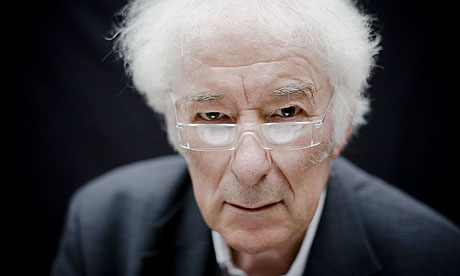
The 92nd Street Y started off their 2011/2012 literature season with a bang by lining up Seamus Heaney as their first speaker. Though the place ended up being virtually sold out, I must have been one of the first to leap on the opportunity to buy a ticket because I was in the very front row, providing me an unobstructed view of the underside of Heaney's chin as he towered above me onstage. (Really, it was awesome being that close.) I have seen some very accomplished authors speak, but this may be the first time I've seen someone so truly legendary. I first read his work because it was in one of those anthologies you have to buy for poetry classes in college that collect all of the significant poetry written in the last 300 years in one volume, and his work was there alongside that of Donne, Milton, Dickinson, Tennyson... Heaney won the Nobel Prize in Literature, the Golden Wreath of Poetry, the T.S. Eliot Prize, and two Witbread prizes, and served as Professor of Poetry at Harvard and Oxford, among other accomplishments too numerous to list here. Also, he was on a STAMP. How cool is that?

Heaney spoke at the Y forty years ago, and they were delighted to have him back. After a flowery introduction by a sprightly, bald poet named Atsuro Riley, Heaney slowly plodded onto the stage. He has tufts of cotton-y hair and wore glasses with rectangular glasses, a striped blazer, and slacks with a perfect crease ironed into them. He spoke, of course, with a delicious brogue that made his poems even lovelier, and unlike the effusive Riley, his language was simple and streamlined. Mostly, particularly when reading his older work, he barely looked down at the text, gazing out into the audience and reciting with perfect smoothness lines he must have said hundreds of times. He read his newer work from a trembling book, and his hands shook as well when he paused to take sips of water; he had a stroke a few years ago, and though he said he's recovered very well, I get the sense that it has slowed him down some. He cracked jokes about esoteric things like iambic pentameter that made his literary audience hoot in a way I can't imagine most crowds would.

Heaney preceded each poem he read with a brief story about how it came to be written or an explanation of a term or figure featured in the poem, which I really enjoyed. It is amazing how much of a backstory there can be to a single phrase. After each poem, however, he took enough time for a breath or two and then plowed into the next one; I'd have appreciated a few moments to savor the last poem before he began a new one. Still, hearing him read his own work was a wonderful experience.

I sat next to two old men who spent the 20 minutes before the reading excitedly passing a book of Heaney's poems back and forth. An old woman behind me let out a "hmmm" after virtually every line Heaney said/read, varying length or the emphasis to fit her reaction; amazing how she was able to express surprise, affirmation, suspense, and pleasure with a single sound, while managing to be consistently irritating all the while. The rest of the audience was vocal as well (though not so frequently). After a particularly poignant line, the place would suddenly seem to vibrate as everyone in the audience murmured "mmmm," in unison. They may have been thoughtful about his work, but many of them were not thoughtful about their behavior. I heard 7 cell phones go off during the performance. (After the third ring, I started keeping a tally).

I was disappointed that Heaney did not sign books afterwards, but he did look pretty beat as he wandered off the stage. (The poor man is 72, after all, though he looked older.) Still, having the opportunity to hearhim read his own work was unforgettable, so perhaps I don't need a souvenir after all.

Friday, September 23, 2011

Meeting Alexandra Fuller

(I must write about my parents' visit, but I have yet to transfer pictures from my camera to my computer. Soon!)

I recently devoured a book called Don't Let's Go to the Dogs Tonight by Alexandra Fuller, a woman who was born in England but moved to Africa shortly thereafter and grew up in various south African countries as her family hopped from farm to farm. I was pleased to learn that she would be speaking at Barnes and Noble for two reasons: 1) I thought the book, a memoir about her childhood, was well-written and fascinating, and 2) author talks at Barnes and Noble are free. I purchased a copy of the book - unfortunately not in paperback yet - from Amazon in preparation. I was surprised by how many people attended. There was quite a crowd to see Sebastian Junger, but he's, well, Sebastian Junger. I figured fewer people would have heard of Fuller. I learned about her books only recently when a friend happened to recommend her, but apparently I was late to the game. The place was packed.

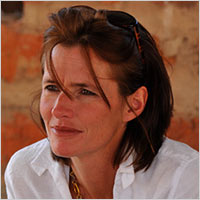
Fuller lives in Montana now. She is short, slender, and has a sort of outgrown bob haircut that manages to be both stylish and casual, and which she musses while she talks. She was dressed, again, simply but fashionably in a plain white button-down blouse with several flow-y scarves and cardigans wrapped around various parts of her. Her accent is absolutely fantastic, a delightful mix of South African and English, and she seems to have inherited the British affection for gallows humor, too. She did some fantastic impressions of her mother, too. (Obviously, I've never met her mother and have no idea how accurate Fuller was, but I certainly enjoyed it.) And she talked about her mother a lot, because her new book, Cocktail Hour Under the Tree of Forgetfulness, is about her mother's life. After reading Dogs, her mother accused Fuller of having no idea who she was, and Fuller realized she was right. She recommends that everyone interview their mother; she said that, like having whooping cough, it was not enjoyable, but that it was an invaluable experience. Fuller did this over the course of a few months, and she said it was remarkably difficult to listen like an author, not like a daughter, and to avoid the pitfalls of judgement or even compassion.

Fuller's mother and a friend!
She read several excerpts from the book. It's tone is similar to that of Dogs, and I was interested to discover that both books are meant to be humorous, albeit darkly so. Fuller's mother was not an easy woman to live with and was often cruel, often unintentionally which makes it even worse somehow, to her children. (She had an extremely difficult life, so it was easy to empathize with and even like her at times.) However, it was clear from listening to Fuller read and discuss that she harbors no hard feelings. How I'd love to meet her! Fuller says that her own daughter went to stay with her grandmother in Africa for a while, and when she returned, exclaimed, "My God, you underwrote that woman!" Hard to believe, because she comes across larger than life in Dogs.. Fuller's mother has a weakness for animals, but otherwise, she's tough as nails. Fuller told about how her mother was attacked by a swarm of African bees, and that her only comment when regarding her swollen face in the mirror afterward was that her wrinkles had vanished, and that she wished she could get the bees to sting the other side so she could take full advantage of "nature's Botox." In a scene from the new book, she dresses her children in costumes for a party, then collects her lipstick, sunglasses, and Uzi to head out the door. Fuller, in her bulky costume, wouldn't fit in the cab of the landmine-proof Land Rover, so her mother tossed her into the trunk. Years later, it occurred to Fuller that the trunk of this Land Rover was NOT landmine-proof, and she confronted her mother about it. "Yes, I knew that," her mother replied, "and if I'd known you were going to grow up to write all these horrible books, I'd have aimed for one." Fuller says her mother is much better parent to a woman in her 40's than she ever was to a child, and the two seem to have an easy-going relationship, filled with the kind of humor Fuller learned to appreciate as she grew older. I can't wait to read this book!

The latest in the collection

Like most authors I've seen, Fuller was remarkably articulate. Each sentence, even answers to audience questions, sounded as though she had pre-written it, thinking carefully about syntax, rhythm, and cadence. She was anything but stuffy, though; in one of the excerpts she read for us, her mother sings a few lines from a song, and Fuller cheerfully sang them for us without a hint of self-consciousness. While signing books after the talk, she looked everyone in the eye, listening patiently to everyone's personal stories about Africa. I'm thrilled that I got to go see her funny, insightful presentation, and I can't wait to read her new book! I heard good things from other people in the signing line about another of her books, Scribbling the Cat, also. Another one for the list!